
3D Drafting & Photorealistic Rendering in High-End Interior Design at Lebesque
What exactly is 3D design?
3D design (or 3D modelling) means digitally developing a design in three dimensions so a space comes to life virtually. Instead of flat 2D plans, the designer creates a digital model with width, height and depth. This virtual model simulates the real world and gives the impression of being truly tangible. A major advantage is that such a 3D model can be viewed from every angle; there is no need to redraw each perspective.
What are the benefits of a 3D drawing for interior design?
A design project creates more trust, better communication and greater client engagement. Because clients recognise their own wishes in the visuals, they can give more targeted feedback and feel like co-owners of the final result. This active role helps ensure that the design aligns more closely with their lifestyle and prevents disappointment during execution.
Moreover, a photorealistic 3D visualisation can convey emotions and atmosphere that are hard to capture with words or flat drawings. A single artist’s impression can make you feel the softness of a fabric, the elegance of wood or the warm glow of lighting in a design. This creates an emotional connection: clients experience the design even before it becomes reality, which makes them even more enthusiastic. As interior designers describe it:
“We make a design not only visible, but also tangible.”
In high-end interior design, 3D drafting has evolved into an indispensable tool. A detailed 3D model now forms the beating heart of the design process and serves as the ultimate visualisation for the client. It offers both private and commercial clients a realistic preview of the final result—long before the first stone is laid. With sharp, photorealistic renders, clients gain a complete impression of their future luxury interior, while skilled craftsmen receive precise instructions for execution.
In this blog post, we take a closer look at what 3D drafting entails, the value it brings to both project and client, and how the process works in practice.
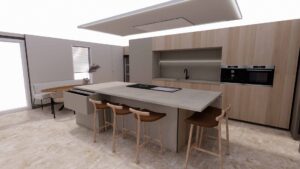
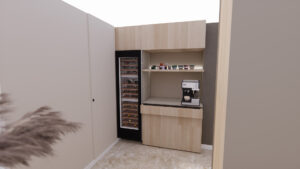
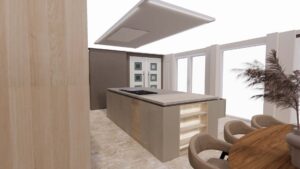
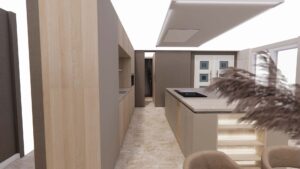
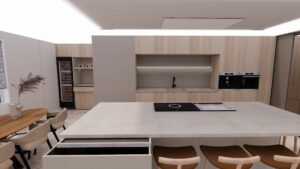
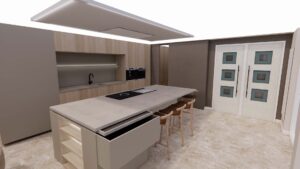
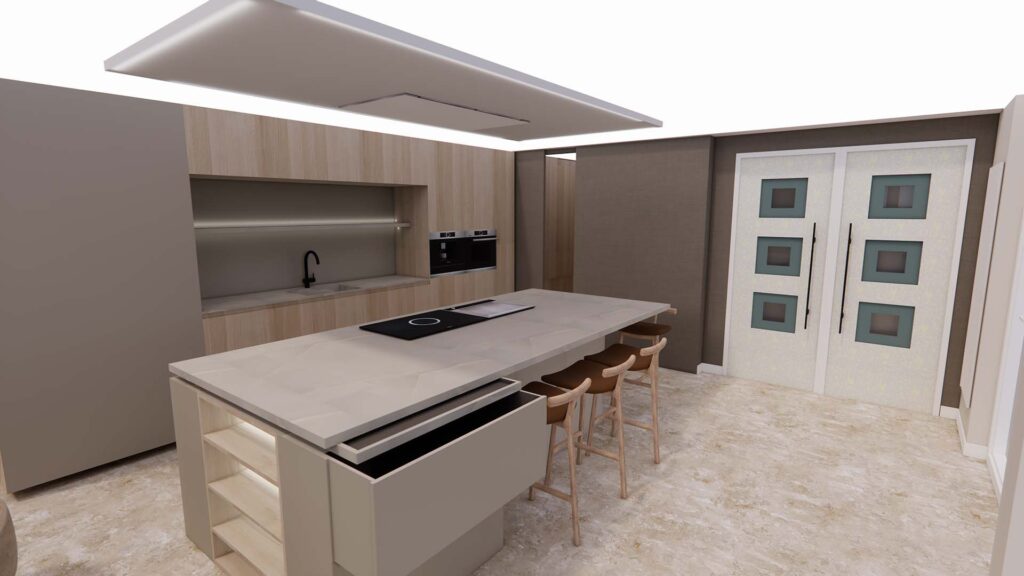
Images of the renderings from the ‘leefkeuken’ project. These renderings illustrate how all materials are represented and provide a clear impression of the final result.
Photorealistic Rendering: Bringing Materials to Life
A basic 3D model shows the shape and layout, but it’s photorealistic rendering that truly brings a design to life. Rendering is the process of transforming the bare 3D model into a lifelike image: realistic materials, colours, shadows and lighting are added. Where the 3D model full of lines and surfaces still feels like a schematic design, rendering turns it into an image that is indistinguishable from a photograph.
For example, you can see the sheen and veining of marble countertops, the interplay of light and shadow on a velvet curtain, and the reflections on a wooden floor. In a good render, materials almost “speak” — the texture and quality are clearly visible, exactly as intended in the design. This enhances the overall experience and ensures that the design appears exactly as the designer envisioned it, with an atmosphere that can be felt immediately.
Precision and Craftsmanship: From Design to Realisation
In addition to convincingly presenting a design to the client, 3D drafting also plays a crucial role in the development and execution phases of an interior project. High-end interiors often contain a great deal of bespoke work—think of custom-built wall units, kitchens, staircases or unique furniture pieces. With 3D design software, the interior designer can develop such elements with millimetre precision.
In a kitchen design, for example, the exact dimensions of cabinets, drawers and countertops are determined and incorporated into the model. This level of precision is invaluable for the craftsmen who will realise the design.
A detailed 3D plan functions as a clear communication tool for the entire project team. Joinery companies, furniture makers, contractors and installers can all refer to the same model or the drawings derived from it, which significantly improves coordination. Such a visual reference point acts as a bridge between disciplines, minimising interpretation errors and mistakes.
How does the 3D design and rendering process work?
The process of 3D drafting and rendering in interior development generally follows several stages. Below is a concise outline of how a design evolves from concept to photorealistic image:
Concept & Layout
Everything begins with identifying the client’s wishes and developing an initial concept. Designers often start by creating a 2D floor plan to determine the ideal layout of the space—positioning walls, doors and furniture to scale.
A mood board is also created to establish the intended atmosphere, colours and materials. This forms a clear programme of requirements and a stylistic direction before the 3D work begins.
Building the 3D Model
Next, the chosen layout is transformed into a complete 3D model. Using specialised software, the designer reconstructs the space step by step: floors, walls and ceilings receive the correct dimensions, and windows and doors are added.
Furniture and objects—often including custom-built elements—are then placed in the model. Everything is drawn to scale so that the 3D model becomes a realistic and coherent representation of the space.
The 3D design shows the space in perspective: you immediately notice circulation routes, whether there is enough distance between furniture pieces, and how different elements relate to one another.
Assigning Colours and Materials
Once the basic model is in place, materials, colours and textures are applied to the surfaces. This is essentially the colouring-in of the digital maquette.
Walls receive paint colours or wallpaper, floors are given wood, tile or carpet textures, and furniture is assigned the intended fabrics or finishes.
A lighting plan is integrated in this phase as well: lamps are added as light sources, and settings are defined for how daylight enters the room (direction, intensity, time of day).
This allows the designer to get an early impression of the atmosphere—how daylight moves through the space, how colours interact and how materials harmonise. This step lays the foundation for convincing renders.
Photorealistic Rendering
The rendering software generates high-quality images of the 3D model. The computer calculates how light moves through the scene and how it reflects off applied materials, resulting in lifelike shadows, reflections and surface details.
The output consists of one or more still images (renders) of the interior, often from various angles or “camera positions”. Sometimes a 360° panorama or short animation is made, but stills usually suffice for presentation and decision-making.
These renders are evaluated and refined where necessary (e.g., adjusting a material or shifting a camera angle). The goal is to create images that come as close as possible to the intended final result. When clients view these photorealistic impressions, they can almost experience the space already.
Revision and Approval
Based on the 3D images, the designer and client discuss any adjustments. Perhaps the client wants to see a different fabric on the sofa or is unsure about an accent colour—this can easily be modified in the model and re-rendered.
This iterative process continues until the client is fully satisfied and the design is approved.
Technical Drawings
Finally, all necessary dimensions and working drawings are extracted from the completed 3D model. Modern 3D software allows designers to generate floor plans, elevations and sections directly from the model.
These 2D drawings—complete with dimensions and technical details—form, together with the 3D model, the package that is passed on to the executing parties.
If you’d like, I can also polish the English text into a more high-end editorial tone that matches Marcel Lebesque’s style.
Visualisation as the Key to a Successful Interior Project
3D drafting with photorealistic rendering is more than a beautiful image — it is the foundation of every successful interior project, especially in the high-end segment. It connects all parties involved: the client fully understands the design and becomes emotionally engaged, the designer can communicate their vision with absolute clarity, and the executing partners receive the precise blueprint needed to bring the design to life.
In a way, a rendered 3D drawing functions as a hyper-realistic scale model of the future space. Where a technical 2D drawing feels like a recipe without ingredients, the photorealistic 3D visualisation is the fully prepared dish: you can already see, feel and almost taste the intended atmosphere long before construction begins. This tangible representation gives both private and commercial clients the confidence to embark on the project with full conviction.
In short, 3D visualisation and rendering have transformed the interior design process. What once was an exclusive luxury has now become a standard expectation in high-end interior development — and rightfully so. It elevates design communication to a higher level and ensures interiors that align perfectly with expectations down to the smallest detail.
Experiencing a future interior virtually has become an essential part of the journey — a journey that ends in a realised design without surprises, but full of satisfaction.